
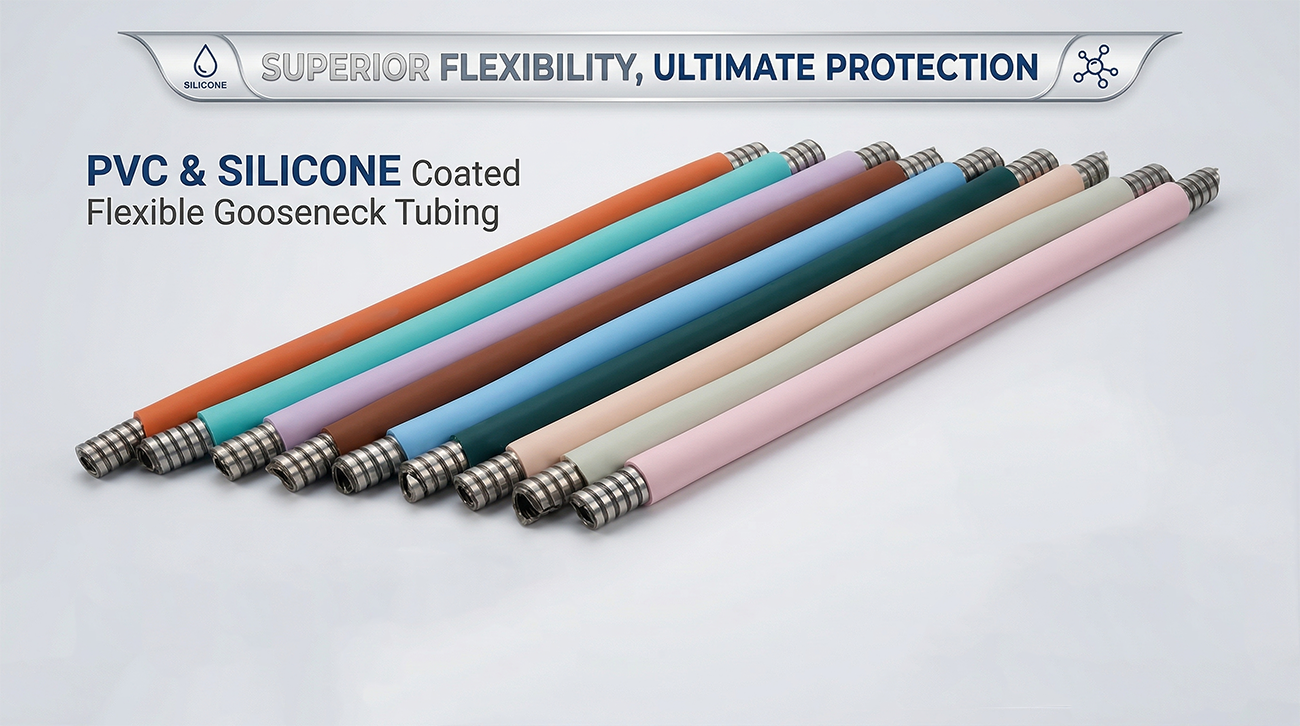
Covering a gooseneck arm changes more than its appearance. The cover affects touch feel, cleaning, abrasion resistance, bend behavior, and sometimes the buyer’s first impression of the product. Silicone and plastic covers both have a place, but they solve different problems.
Silicone is often chosen when users touch the arm often. It has a softer, warmer feel than hard plastic and can make a product feel less industrial. That matters for bedside holders, medical lamps, dental equipment, consumer accessories, and products handled by patients or customers.
A soft-touch cover can also reduce the “metal tube” feeling on a product that is meant to look friendly. Pages such as soft-touch silicone covered gooseneck holders show why the cover can be part of the product experience, not just protection.
Plastic, PE, and similar covers are often used where oil, dust, abrasion, and cost matter. Machine tool lights and industrial task lamps may need a cover that is easy to wipe down and does not absorb grime. In those cases, the design target is not softness. It is durability and repeatable cleaning.
For CNC or machine tool environments, pages like oil-resistant CNC PE covered goosenecks are a better reference than consumer holder examples.
Medical and dental equipment often pushes the choice toward seamless, smooth, cleanable covers. A rough or segmented surface can trap dirt. A smooth silicone sleeve may be more suitable when staff clean the arm regularly.
That said, cleaning chemicals should be discussed early. The same material can behave differently depending on disinfectant, oil, heat, and exposure time.
A cover is not mechanically neutral. A thick sleeve can make the arm feel larger and slightly different when bent. It can also affect the minimum bend radius. For small-diameter goosenecks, the cover can become a meaningful part of the hand feel.
If the design has tight spaces or needs a slim visual profile, the cover should be tested on a real sample, not added after the mechanical design is finished.
Silicone can make a device look more refined or medical. Plastic can look cleaner and more technical when the finish is consistent. Color matching may be possible with both, but exact color, gloss, and texture should be approved with physical samples.
For products where color is central to the design, it may be worth comparing covered tubing with color finished flexible tubes.
The cover should be chosen together with the tube, fitting, and environment. Treating it as a cosmetic afterthought is how projects end up with arms that look right but feel wrong in use.