
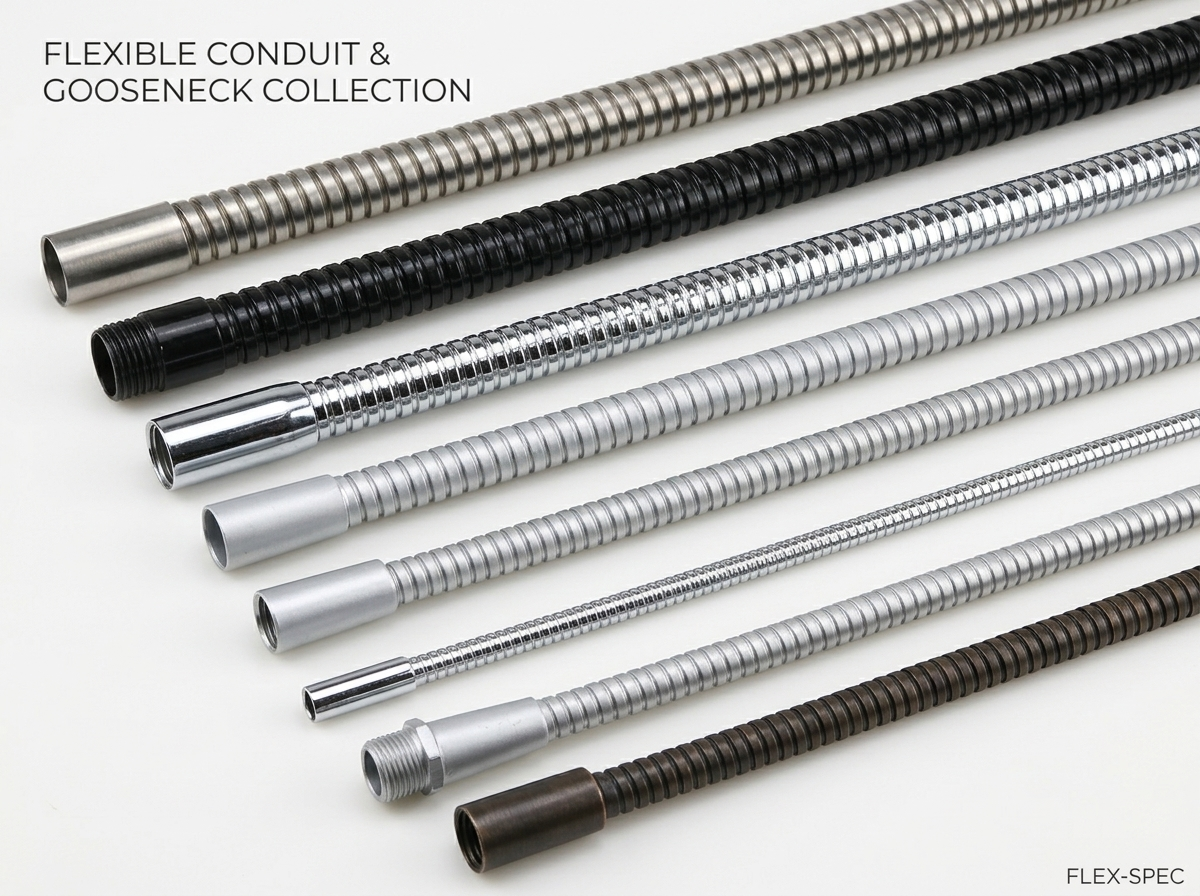
When a buyer asks for a “strong” gooseneck arm, the first useful reply is not a catalog number. It is a question: strong in which direction, at what length, and with what mounted on the end?
Gooseneck stiffness is easy to overspecify on paper. A tube that feels excellent on a test bench can be annoying in daily use if the operator needs two hands to move it. The opposite mistake is more common: the arm feels smooth when unloaded, then slowly drops once a lamp head, scanner, microphone, or tablet is attached.
The working length is the unsupported length between the fixed base and the load. A 300 mm arm and a 600 mm arm made from the same tube do not behave like the same product. The longer arm has more leverage, so it needs either a stiffer tube, a lighter head, a better base, or a shorter expected reach.
For small lamps, microphones, and compact sensors, a lighter tube may be easier to position. For machine lights, medical lamps, barcode scanners, or antenna supports, stiffness usually matters more than a soft hand feel. This is where pages like industrial lighting goosenecks and industrial scanner stands can help frame the use case.
Two “tablet holders” can need very different arms. A small bedside phone holder may only carry a light device at a short reach. A retail display holder may need to resist repeated adjustment, vibration, and customer handling. A medical cart mount has another set of concerns: cleaning, stability, and predictable position near equipment.
A practical starting point is to list the load weight, center of gravity, required arm length, typical bend shape, and how often the arm will be adjusted. A frequently repositioned arm should not be so stiff that staff avoid using it. A rarely adjusted inspection light can be much firmer.
A stiff arm on a weak base still feels unstable. Clamp, flange, weighted base, magnetic base, and side bracket designs all change the final behavior. If the arm is mounted on a thin panel, a high-torque tube can transfer too much force into the mounting surface. For this reason, stiffness decisions should be made together with the base. The gooseneck arm components section is a better reference than a tube-only drawing.
Many failures come from asking the arm to hold a very tight bend again and again. A tighter bend increases local stress and can shorten service life, especially if the product is adjusted daily. A larger bend radius usually gives a smoother feel and better durability.
If the design needs a sharp turn near the mounted device, it may be better to use a short rigid fitting plus a moderate gooseneck bend, rather than forcing the tube into a hard kink.
Short sample pieces can be misleading. A 100 mm sample may feel firm, but the same tube at 450 mm may not hold the final load. For OEM work, the sample should be close to the real length and fitted with a test weight that represents the finished device.
That simple test often prevents the two classic mistakes: choosing a tube that sags after installation, or choosing one so stiff that users fight it every day.
For custom projects, stiffness is not a single number in isolation. It is a balance between holding force, user feel, mounting strength, and service environment. The best gooseneck arm is the one that holds the product confidently without making normal adjustment harder than it needs to be.