
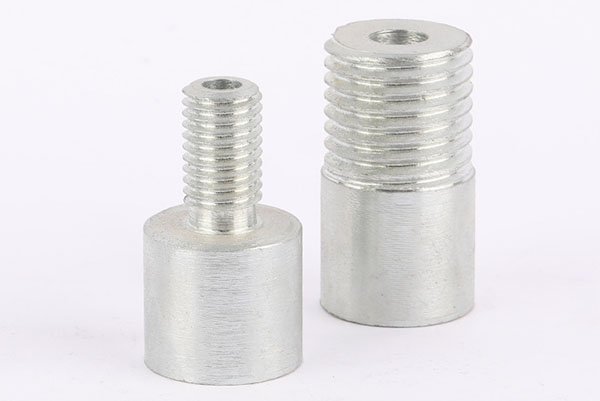
The gooseneck tube gets most of the attention, but end fittings often decide whether the assembly installs cleanly or becomes a headache. A good tube with the wrong fitting is still the wrong part.
For OEM work, end fittings should be specified at the same time as tube length, diameter, stiffness, and finish. Waiting until the end usually creates rework.
M8 and M10 threads are common on lamps, brackets, small equipment supports, and many industrial assemblies. They are compact, familiar, and easy to source. The important details are thread pitch, thread depth, shoulder design, and whether the fitting needs a flat, hex, or special locking feature.
If the arm will be adjusted often, the fitting should also be checked for loosening under repeated torque. A thread that works on a static bracket may not be enough for a frequently repositioned arm.
The 1/4-20 thread is common in camera, webcam, lighting, and tripod accessories. It is useful when the gooseneck must connect to off-the-shelf mounts or ball heads.
For studio products, a 1/4-20 tripod ball-head fitting can reduce custom work and keep the product compatible with familiar accessories.
NPT and BSP threads show up more often in industrial equipment, conduit-style assemblies, and products that already use pipe thread standards. The main risk is assuming “pipe thread” is enough detail. NPT and BSP are not the same, and taper, sealing, and engagement length must be checked.
For these projects, a page like NPT and BSP threaded fittings is a useful starting point.
Custom ends make sense when the assembly needs a specific shoulder, groove, cable passage, anti-rotation feature, or decorative transition. They are also common when the gooseneck must fit into an existing plastic housing or die-cast part.
A custom end does not have to be complicated, but it should be designed around assembly. Ask how the part will be tightened, whether tools can reach it, and whether the cable needs to pass through the fitting.
For USB lights, sensors, microphones, and small electronics, the end fitting may need an internal passage. The hole size, edge radius, and strain relief matter. A sharp internal edge can damage a cable long before the gooseneck itself fails.
This is especially important for USB integrated gooseneck arms and other wired assemblies.
End fittings are small parts, but they carry a lot of responsibility. Getting them right early makes the rest of the gooseneck project much easier.